

What 40,294 Finch App Reviews Reveal About Emotional Attachment and Product Loyalty
Published 24th August, 2026 by Claire McGregor
One reviewer lost access to their Finch account after maintaining a two-year streak. They didn't write about it as lost data. They wrote about losing "my birb jelly".
That's the pattern running through Finch's reviews. Users name their virtual birds, describe them as companions and talk about returning because their bird is waiting for them. For many reviewers, the bird isn't simply a cute character attached to a self-care app. The relationship with it appears to be part of the product itself.
In this overview you'll learn:
- About the Finch app review data
- Why Finch users become attached and keep coming back
- When data loss feels like losing more than data
- Product love doesn't guarantee pricing satisfaction
- Emotional products are judged by relationship standards
- What Finch teaches us about building apps people care about
- How we used the Appbot MCP to find the pattern
Explore your app reviews with AI
The Appbot MCP connects your app reviews to the AI tools you already use, so you can ask questions and get data-backed answers about your users.
Try Appbot free for 14 days →
We analysed 40,294 Finch reviews from the Apple App Store and Google Play between 7 August 2025 and 6 August 2026. Across the year, the self-care app averaged 4.59 stars, with 82.1% of reviews classified as positive by Appbot. Those numbers make Finch a highly rated app. They don't explain why users talk about it the way they do.
The relationship does. It may explain why some users who normally abandon habit apps report sticking with Finch, and it raises the stakes when things go wrong: lost data, billing problems and poor support can feel more significant when users are emotionally invested in what they've built.
For teams building virtual pets, AI companions, wellbeing apps, games or other products designed to create an emotional connection, Finch offers an interesting look at both sides of emotional product design.
About the Finch app review data
We analysed Appbot app review data for Finch on iOS and Google Play over a 12-month period from 7 August 2025 to 6 August 2026.
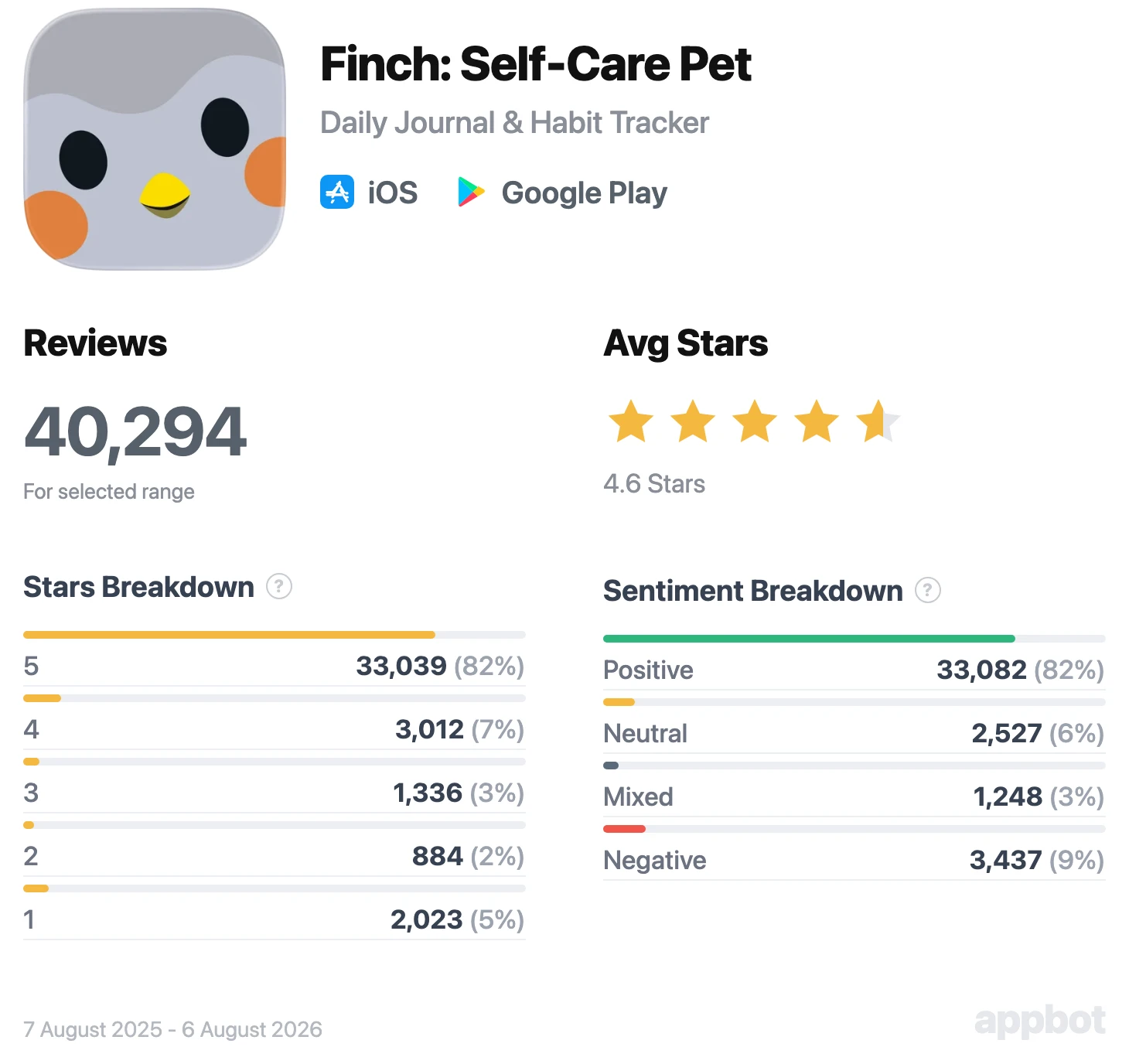
iOS contributed 16,942 of those reviews at an average of 4.63 stars, while Google Play contributed 23,352 at 4.56. Sentiment followed the same pattern: 83.0% of iOS reviews were classified positive against 81.5% on Google Play, with negative sentiment at 7.5% and 9.3% respectively.
The shape of the distribution matters as much as the average. 82.0% of all 40,294 reviews are five-star, and the curve doesn't taper smoothly from there: one-star reviews, at 5.0% of the total, outnumber both the two-star (2.2%) and three-star (3.3%) groups. That love-it-or-hate-it pattern matches what the review text goes on to show: strong attachment at one end, and account and data-loss stories at the other.
We analysed the reviews with an AI agent through the Appbot MCP, which gives agents access to Appbot's Sentiment and Topics analysis alongside the underlying review text. The deeper analysis focused on 1,600 reviews: 600 iOS negative or mixed reviews, 600 Google Play negative or mixed reviews, and 400 positive reviews, 200 from each platform.
The sample skews toward English-language reviews, and review data tells us what users say about their experiences rather than proving causation. Where reviewers associate their Finch bird with continued use, for example, we can identify that pattern without claiming emotional attachment alone caused retention.
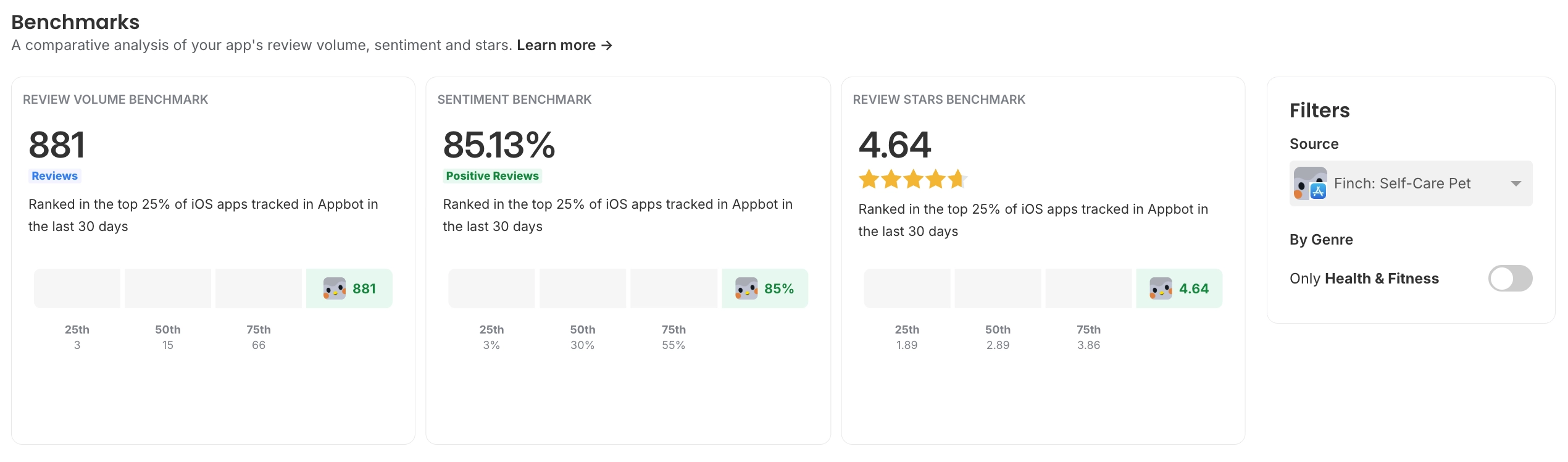
Finch's numbers also hold up well beyond the self-care category. Appbot's Benchmarks place Finch in the top 25% of apps tracked in Appbot on both platforms for review volume, positive sentiment and star rating. Over the last 30 days, half of the iOS apps tracked in Appbot averaged below 2.89 stars and half sat below 30% positive sentiment; Finch came in at 4.64 stars and 85% positive. On Google Play those midpoints were 3.36 stars and 47% positive, against Finch's 4.51 stars and 80%. Volume tells the same story: Finch collected 881 iOS reviews in 30 days, while half of the tracked iOS apps received 15 or fewer, and 1,463 on Google Play, where the midpoint was 28.

Why Finch users become attached and keep coming back
Of the 400 positive reviews included in the deeper analysis, 88 contained language relating to the pet being cute, named or emotionally significant, while around 96 reviews across the full 1,600-review sample named the bird directly.
Reviewers use phrases such as "my birb Dwight" in the same way someone might refer to a real pet, while others describe companionship, responsibility and not wanting to let their bird down. One reviewer with ADHD and anxiety described feeling as though their bird, Dwight, needed them.
The pattern is not new, either. Three years before our analysis window, a reviewer was already describing the bird as too cute to disappoint:
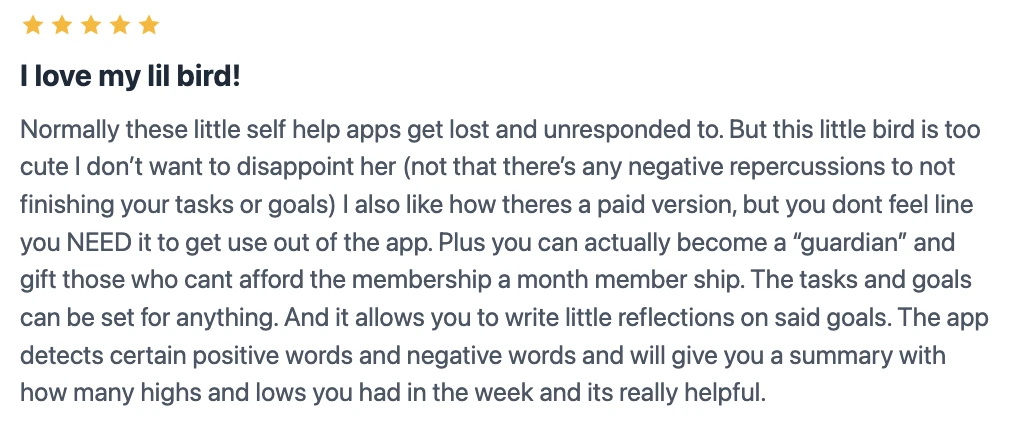
What stands out isn't simply that users find the character cute. Finch's reviews instead suggest that attachment develops through reciprocity. Users look after their bird by looking after themselves, while the bird provides encouragement, companionship and progress in return.
Among the 400 positive reviews analysed, 34 explicitly referenced experiences including depression, anxiety, ADHD, PTSD or grief, while another 24 discussed self-care, mindfulness or journaling. One reviewer had lost her mother:
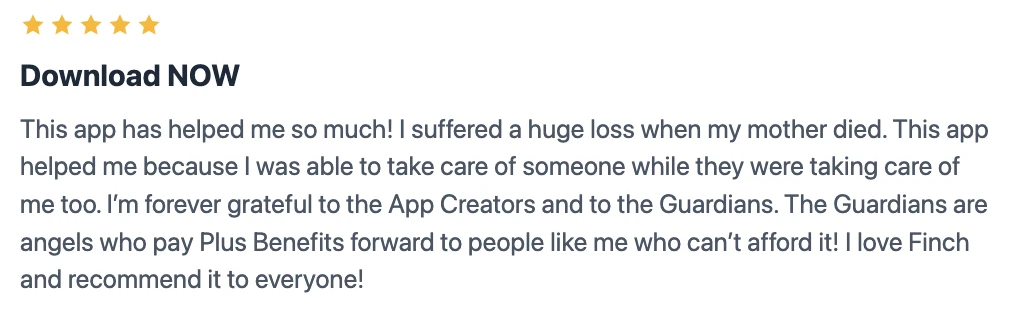
These reviews aren't evidence that Finch can replace professional mental health care. They do, however, show how some users understand the product. The bird isn't simply decoration layered over a habit tracker because the perceived relationship changes how they experience the activities underneath it.
The app is embedded in some users' routines to a striking degree. One reviewer, who identified herself as a psychologist, said she used it daily herself and recommended it to clients:

That relationship also appears alongside stories about continued use. Habit and routine building appeared in 74 of the 400 positive reviews. One Google Play reviewer who said they usually abandon apps after two or three days celebrated reaching a 20-day streak with Finch.
Product analytics can show that someone came back on day 20 or day 200. Their review can sometimes tell you why.
When data loss feels like losing more than data
The same attachment visible in Finch's positive reviews changes the nature of some of its negative feedback.
Across the 1,200 negative and mixed reviews sampled, Appbot's Topics identified Bugs in 32% of the iOS reviews and 21% on Google Play. Keyword analysis also found 28 reviews explicitly describing lost progress, birds or accounts.
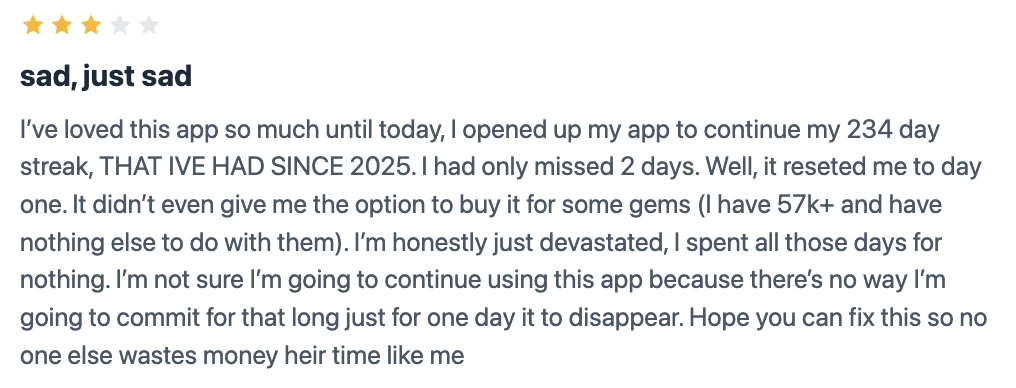
One iOS reviewer described their bird becoming corrupted and disappearing three times. Another opened the app expecting to continue a 234-day streak and found themselves reset to day one:
And the review this article opened with, in full:
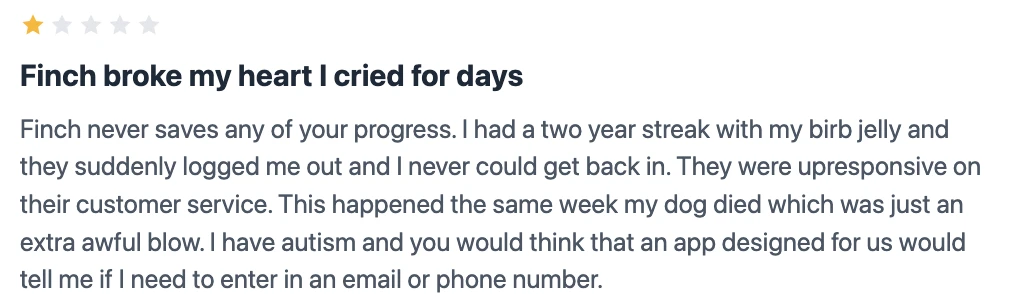
These users aren't only reacting to lost data. They've named and customised something, cared for it and accumulated memories around it, sometimes for years. For a utility app, serious data loss can mean a one-star review and a lost customer. When users have spent years caring for a virtual character, the same failure carries considerably more emotional weight.
When users become attached to what you're storing, backup, sync and account recovery become part of the user experience.
Product love doesn't guarantee pricing satisfaction
Emotional attachment doesn't mean users will overlook problems elsewhere in the product. Pricing was tagged in 27% of sampled iOS negative/mixed reviews and 21% on Google Play, while Payment appeared in 16% and 11% respectively. Subscription-cost complaints appeared in 83 of 600 iOS reviews and 60 of 600 Google Play reviews.
The trial-to-paid experience was particularly noticeable. 42 iOS reviews and 38 Google Play reviews, around 6.7% of the negative/mixed sample, mentioned free-trial auto-charges or billing surprises. Reviewers described unexpected charges, cancellation issues and difficulties obtaining refunds.
Some of those complaints appeared alongside positive comments about the app itself. Users can love their bird and still be unhappy with the way they're being charged. For emotionally engaging products, trust around billing matters just as much as the experience inside the app.
Emotional products are judged by relationship standards
Once users associate qualities such as kindness, care and companionship with a product, they may begin applying those expectations to the company behind it. During June and July 2026, some iOS reviewers criticised monthly cosmetic themes for not providing enough textured-hair options. In the first few days of August, a small group also objected to advertising content they believed was AI-generated. These weren't high-volume complaint categories, but some users framed their criticism as disappointment in a product they otherwise cared about.
The same effect appears in support feedback. Customer Support was tagged in 16% of sampled iOS negative/mixed reviews and 10% on Google Play, with reviewers describing slow responses and unresolved billing or account problems.
Developer replies appeared on only 2 of the 1,200 sampled negative reviews. Support may have taken place elsewhere, so this doesn't mean Finch responded to only two customers. It does mean that people reading those reviews rarely see a public developer response alongside the complaint.
When a user has lost something they've cared for over months or years, the problem may not feel like an ordinary sync or account issue. The support experience needs to recognise that emotional investment while still resolving the underlying problem quickly and clearly.
What Finch teaches us about building apps people care about
Finch has done something most products never manage. Users who say they abandon habit apps after two or three days describe streaks running into months and years, and they credit a bird they named.
The reviews suggest that comes from mutual care rather than character design. Users look after the bird by looking after themselves, and get encouragement, companionship and progress back. Cuteness attracts attention. The exchange is what makes people feel responsible.
That sense of responsibility is also what makes failure expensive. The reviewer who lost "my birb jelly" after two years wasn't filing a sync bug, and the reviewer who watched a 234-day streak reset to day one didn't write about it as a database error. For products like this, backup, account recovery, billing and support aren't infrastructure sitting behind the experience. They are part of the experience, and users judge them against the standards the product itself set.
That's the trade emotional design makes. Attachment can earn loyalty that streaks and scores struggle to buy, and it gives users a reason to take your mistakes personally. Both arrive through the same review pipeline, often from the same people.
Analytics can tell you that users came back. Reviews can tell you why, and they will often show you what is straining the relationship well before it shows up in your retention numbers.
How we used the Appbot MCP to find the pattern
We wanted to understand something the topline numbers couldn't show: why were some users so emotionally attached to Finch, and how did that relationship affect the way they talked about the product?
The Appbot MCP lets AI agents securely access and analyse Appbot app review data, including Appbot's Sentiment and Topics analysis. Working through the MCP, our agent used Topics to surface the recurring complaint categories, Bugs, Pricing, Design & UX, Payment and Customer Support, then explored the reviews behind them in natural language: how users described their birds, whether they named them, why they said they kept using Finch and how they talked about losing progress. The same connection ran the keyword searches and counts that quantified what came back.
That surfaced a pattern the ratings couldn't show. Users weren't simply saying they liked the bird. Many were describing responsibility, companionship and care running in both directions. "The app lost my data" describes a software problem. "I had a two year streak with my birb jelly" tells you what that problem meant to the user.
For example, you could ask your AI agent:
- Why do our most loyal users keep coming back?
- Which problems frustrate otherwise happy users?
- Are pricing complaints coming from people who otherwise love the app?
You don't need to know exactly what you're looking for before you start. In Finch's case, asking broader questions revealed a relationship between emotional attachment, continued use, expectations and reactions when the product fails. That's an insight a 4.59-star average alone couldn't tell us.
Explore your app reviews with AI
The Appbot MCP connects your app reviews to the AI tools you already use, so you can ask questions and get data-backed answers about your users.
Try Appbot free for 14 days →Where to from here?
- Discover effective strategies for app review management to efficiently handle and leverage user feedback.
- Unlock valuable insights into user sentiment with our powerful sentiment analysis tool for informed decision-making.
- Simplify your review tracking process with our efficient review aggregator, providing a centralized view of user feedback.
- Engage with your users effectively by crafting thoughtful responses with our convenient Reply to App Store Reviews feature.
About The Author

Claire is the Co-founder & Co-CEO of Appbot. Claire has been a product manager and marketer of digital products, from mobile apps to e-commerce sites and SaaS products for the past 15 years. She's led marketing teams to build multi-million dollar revenues and is passionate about growth and conversion optimization. Claire loves to work directly with the world's top app companies delivering tools to help them improve their apps. You can connect with her on LinkedIn.
Enjoying the read? You may also like these
 We Searched 866 App Reviews of an Apple Design Award Winner for “Delight”
 The word “delight” appeared in 0.6% of grug’s 866 app reviews. The feeling appeared in 42%. What review mining reveals that star ratings and keyword searches miss.
We analyzed 11,090 Claude app reviews after Fable 5 returned. See how user sentiment shifted from availability to pricing, limits and trust.
Curious about the gap between app ratings and review stars? We analyzed 4,000+ apps to uncover suprising trends, patterns and what "normal" really looks like. Dive into the data and see what we found!
App reviews surface bugs, feature requests, usability problems and the language users use to describe your app. What each insight looks like and who acts on it.