

Why Generic AI Isn't Enough for App Ratings and Review Feedback Analysis
Published 1st July, 2026 by Stuart Hall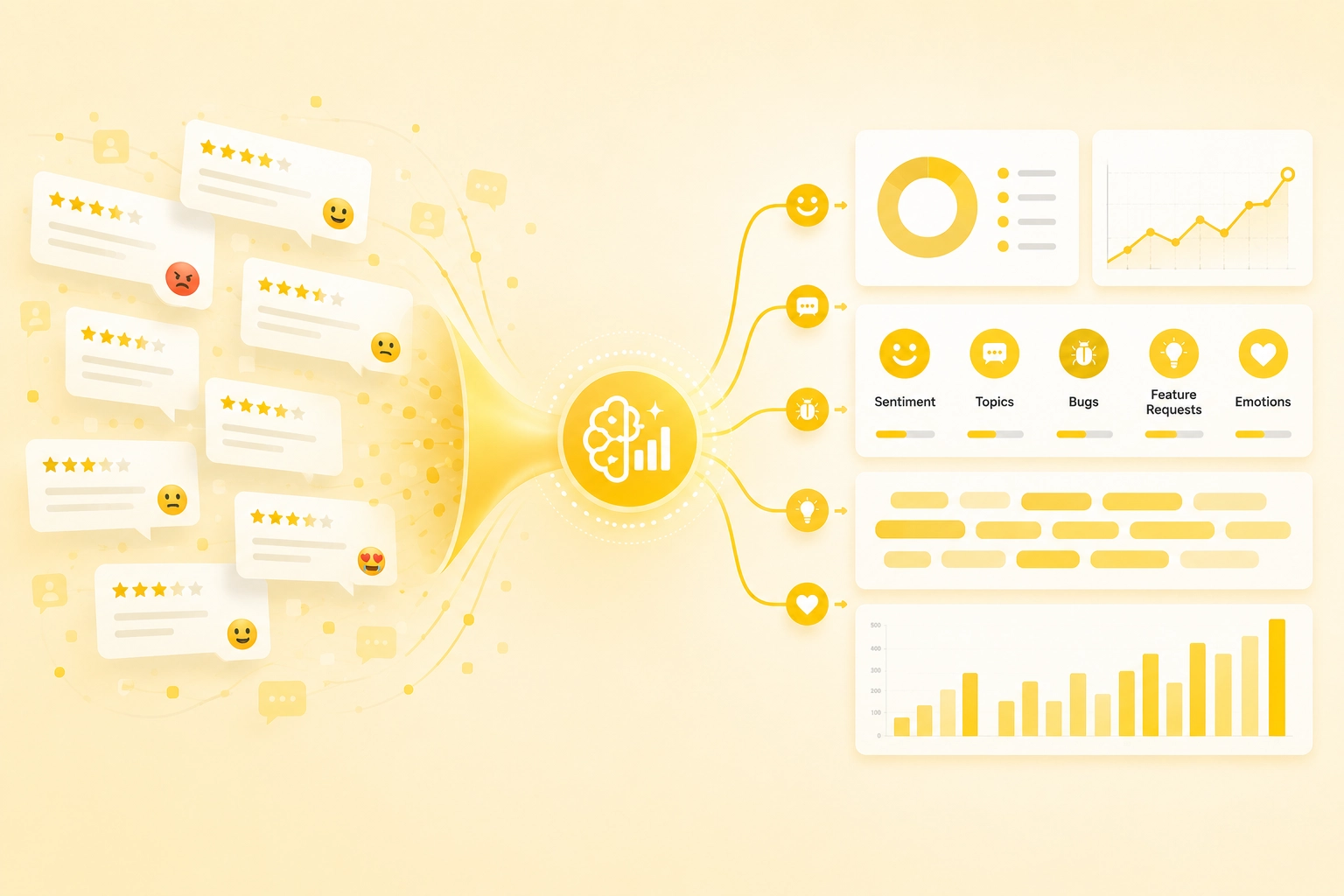
AI Large language models (LLMs) are exceptional at reasoning, writing, and summarising information. But analysing customer app feedback requires more than language understanding. It requires consistent, evidence-based customer intelligence that app and product teams can trust over time.
In this article, we'll explain why simply giving AI access to app ratings and reviews isn't enough, why specialist customer feedback analysis matters, and how combining structured customer intelligence with modern LLMs produces far more reliable insights.
In this overview you'll learn:
- Why Generic AI Isn't Enough for Customer Feedback Analysis
- LLMs Are Reasoning Engines, But Not Deterministic
- Access to Reviews Isn't the Same as Understanding Them
- Raw App Reviews Aren't Customer Intelligence
- Three Things Every Customer Feedback AI Needs
- The Future Is AI Plus Customer Intelligence

Stop just reading reviews. Start asking questions.
Try Ask Appbot, free for 14 days →Why Generic AI Isn't Enough for Customer Feedback Analysis
Artificial intelligence has transformed knowledge work. Large language models (LLMs) draft emails, summarize research, write code, and brainstorm product ideas. For many teams, AI is now as essential as search engines and spreadsheets.
That raises a fair question: if AI can explain quantum computing and write a marketing plan, can it accurately analyze your app ratings and reviews?
The short answer is yes, but only when it has the right evidence, specialist expertise, and a consistent way to measure feedback over time. Customer feedback analysis isn't just a reasoning problem. It's a customer intelligence problem.
LLMs Are Reasoning Engines, But Not Deterministic
LLMs excel at understanding, organizing, and transforming information. They identify patterns, connect ideas, and generate responses that are often genuinely insightful.
However, they aren't deterministic reasoning systems. Given the same question, an LLM may produce different responses, particularly when there isn't a single factual answer. Their role is to predict the most likely response based on the information available, not retrieve a fixed, verified fact.
That makes them ideal for writing, brainstorming, and problem-solving. Business decisions, however, require answers grounded in evidence, facts, and consistent analysis, not simply the most plausible explanation.
When you're deciding which bug to prioritize, whether a release improved customer satisfaction, or which feature to build next, you need answers grounded in evidence and measured consistently over time.
Access to Reviews Isn't the Same as Understanding Them
It's tempting to think the gap disappears the moment an LLM can read your reviews. With MCP servers, AI connectors, and APIs becoming increasingly common, access to customer feedback is easier than ever.
But access is only the starting point. Even with every app review you've ever received, an LLM still begins with thousands, or millions, of pieces of unstructured text. It must determine:
- The topics each review relates to
- The sentiment and emotions customers are expressing
- The context behind the feedback
- When multiple reviews are describing the same issue using different language
- Which patterns represent meaningful trends that product teams should act on
Customer app reviews are unlike most business data. Revenue is a number. Conversion rate is a percentage. Customer app reviews are messy.
People combine praise and criticism in the same sentence. They use sarcasm, humour, emojis, abbreviations, slang, and product-specific terminology that makes perfect sense to existing users but very little sense to outsiders.
Positive and negative sentiment in the same review: 
Sarcasm disguised as praise: 
Humor describing a poor experience: 
A person understands these almost instantly. Now imagine analysing millions of app reviews across thousands of apps, dozens of languages, and years of customer feedback.
That's no longer simply a text-processing problem. It's a specialist customer intelligence problem.
Raw App Reviews Aren't Customer Intelligence
Giving an LLM access to app reviews is only the beginning.
Raw reviews don't explicitly tell you whether complaints about onboarding are increasing, whether sentiment toward a feature has improved, or whether a spike in one-star reviews reflects a genuine trend or just a handful of isolated incidents.
Turning raw reviews into actionable intelligence requires specialist analysis.
That's exactly what Appbot is built to do.
Over many years, we've developed purpose-built customer intelligence models and analytical systems specifically for app ratings and reviews. Every review is analysed to identify structured signals including:
Because every review is analysed using the same purpose-built framework, product teams can compare releases, identify emerging issues, and measure trends consistently over time.
Instead of asking an LLM to interpret thousands of raw reviews from scratch every time, Appbot first transforms those reviews into structured customer intelligence.
The LLM can then reason over consistently classified Sentiment, Topics, Custom Topics, Bugs, Feature Requests, Emotions, Keywords, Ratings, review metadata, and historical trends.
The result is faster, more consistent, and more reliable answers than analysing raw review text alone.
Three Things Every Customer Feedback AI Needs
Reliable customer feedback analysis depends on three capabilities working together.
1. Access
Without complete app ratings, reviews, and their associated metadata, AI has no evidence to reason over.
2. Expertise
Customer reviews aren't books or news articles. Mixed sentiment, sarcasm, feature-specific terminology, and the many ways users describe the same issue require analytical models built specifically for app review analysis.
3. Consistency
Analytics isn't just about understanding today's reviews. It's about measuring change over time.
Product teams need confidence that today's sentiment can be compared with last month's and last year's using the same analytical framework.
LLMs are deliberately probabilistic rather than deterministic. That's one of the reasons they excel at conversation and creative work. Analytics, however, depends on stable, repeatable classifications that remain consistent regardless of when the question is asked.
Together, these capabilities transform a general-purpose LLM into a reliable customer intelligence system.
The Future Is AI Plus Customer Intelligence
Large language models are exceptional reasoning engines. Appbot is a customer intelligence platform built specifically for app ratings and reviews. Those are different strengths and they complement each other.
Appbot transforms millions of unstructured app reviews into structured customer intelligence. Modern LLMs then reason over that intelligence to answer complex product questions in plain English, not from raw review text, but from consistently and accurately measured Sentiment, Topics, Custom Topics, Bugs, Feature Requests, Emotions, Keywords, Ratings, review metadata, and historical trends.
The result is AI that doesn't just generate plausible answers. It delivers answers grounded in structured customer intelligence, giving product teams evidence they can trust.
Appbot transforms app ratings and reviews into customer intelligence. Modern LLMs transform that customer intelligence into answers. Together, they enable faster, smarter, and more confident product decisions.
Stop just reading reviews. Start asking questions.
Try Ask Appbot, free for 14 days →Where to from here?
- Discover effective strategies for app review management to efficiently handle and leverage user feedback.
- Unlock valuable insights into user sentiment with our powerful sentiment analysis tool for informed decision-making.
- Simplify your review tracking process with our efficient review aggregator, providing a centralized view of user feedback.
- Engage with your users effectively by crafting thoughtful responses with our convenient Reply to App Store Reviews feature.
About The Author

Stuart is Co-founder & Co-CEO of Appbot. Stuart has been involved in mobile as a developer, blogger and entrepreneur since the early days of the App Store. He built the 7 Minute Workout app in one night and blogged the story of growing the app to 2.3 million downloads before exiting to a large fitness device company. Previously he was the co-founder of the Discovr series of applications which achieved over 4 million downloads. You can connect with him on LinkedIn.
Enjoying the read? You may also like these
 The New Era of App Discovery: What App Growth Teams Need to Know About ASO, SEO & AI
 App discovery is changing. Learn how ASO, SEO, and AI now work as one system—and how app copy, reviews, and release notes drive discovery.
Learn how Apple’s new Retention Messaging API helps reduce app subscription churn with personalized, in-the-moment messages. Backed by research, this guide shows how to combine App Store feedback, discounts, and smart messaging to boost retention.
A complete guide to App Store product page optimization in 2026 — custom product pages, A/B testing, and metadata that converts more installs.
What the new Apple and Google age-verification requirements mean for your app, and which APIs to use to comply without hurting the user experience.