

Claude Fable 5 Came Back. Users Had a Different Complaint.
Published 10th August, 2026 by Claire McGregor
What 146 app reviews revealed about pricing, trust, and why ratings still weren't telling the whole story.
In June, we analyzed 15,514 Claude app reviews around the launch, and sudden withdrawal, of Claude Fable 5.
Our biggest finding wasn't about the app reiews and their ratings. It was that users often gave the model five stars while writing frustrated app reviews because Fable had disappeared. When Anthropic brought Fable 5 back on July 1, we expected that conversation to disappear too. Instead, it changed.
Rather than asking "Where did Fable go?", reviewers started asking "Why am I paying extra for it?"
In this overview you'll learn:
- The Ratings for App Reviews Barely Changed
- App Review Ratings and Sentiment Diverged Again
- The Conversation Shifted from Access to Pricing
- A New Topic Appeared
- Timing Told the Story
- Android and iOS Users Reacted Differently
- Reviews Aren't Static
- What Product Teams Can Learn
- How Can You Find Changes Like This in Your Own App Reviews?
- Frequently Asked Questions

Want to find out what changed in your own app reviews?
Try Ask Appbot, free for 14 days →We analyzed another month's worth of feedback: 11,090 app reviews from July 1 to August 1, including 146 reviews mentioning Fable, more than double the number from our original study.
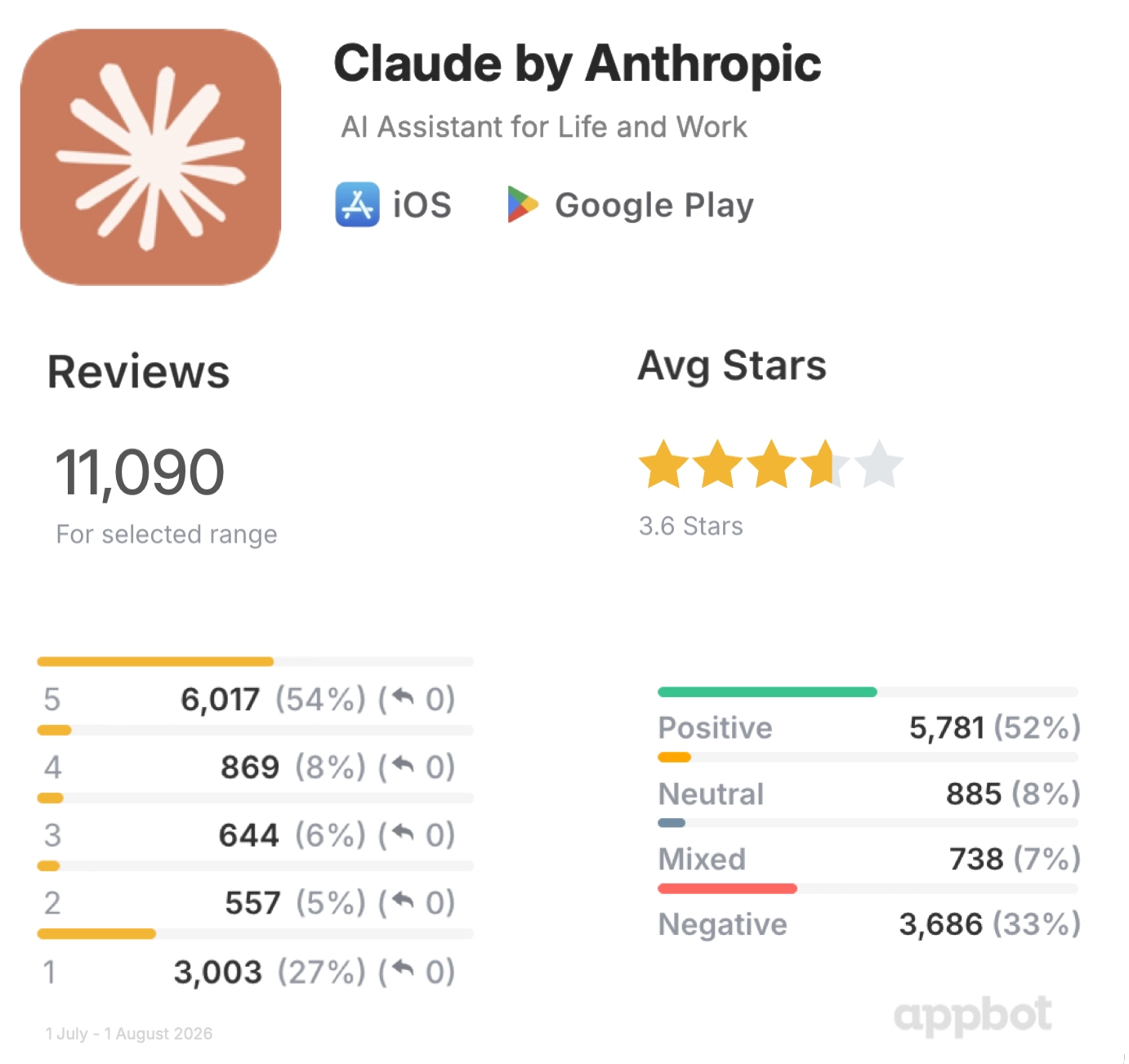
The average app ratings barely moved, but the conversation did.
The Ratings for App Reviews Barely Changed
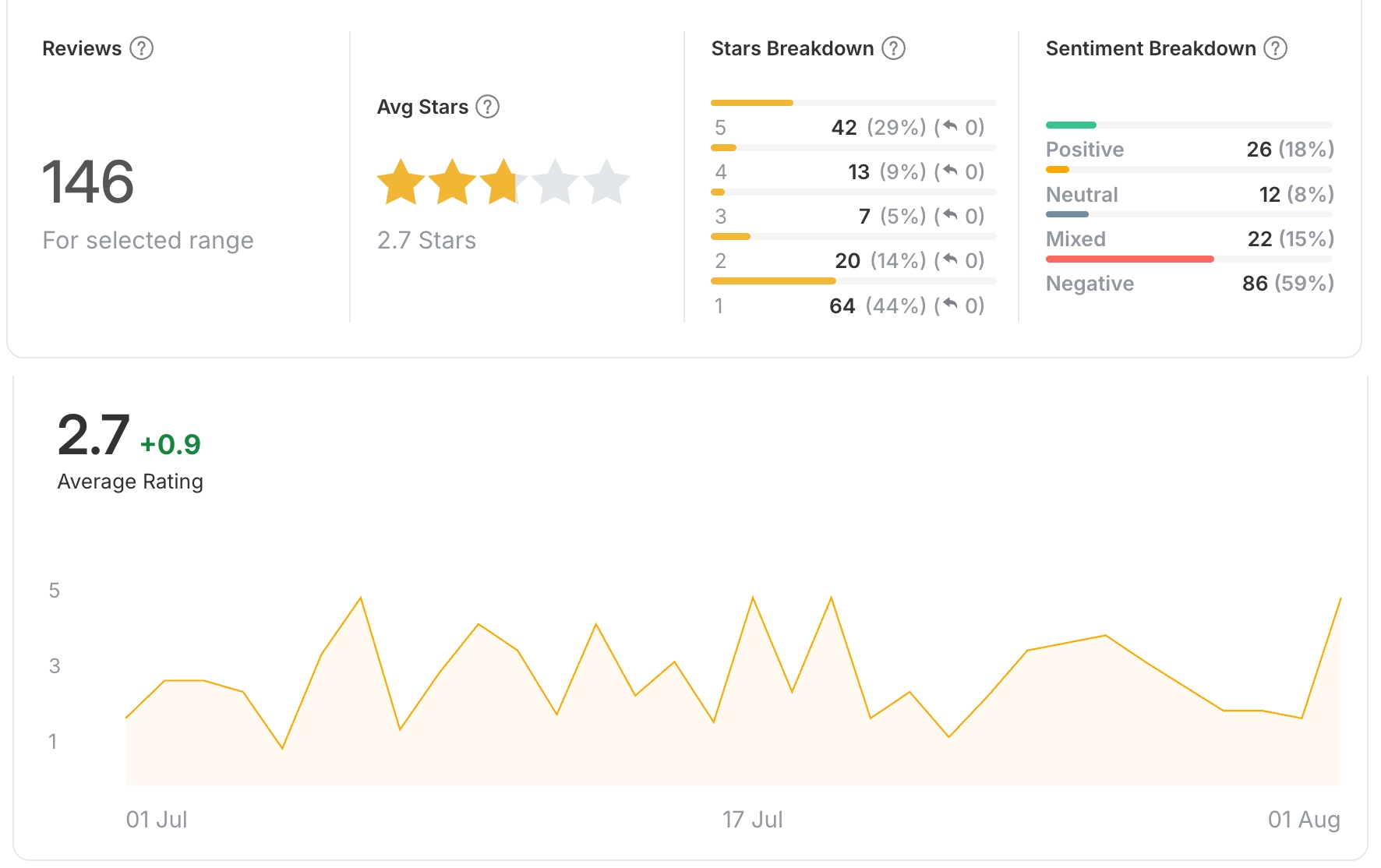
At first glance, the July data looks remarkably similar to June. The average Fable review was 2.65 stars, compared with 2.5 stars in our previous analysis.
| Rating | July | June |
|---|---|---|
| ★★★★★ | 28.8% | 31.3% |
| ★★ | 13.7% | n/a |
| ★ | 43.8% | 57.8% |
One note on that dashboard: the +0.9 beside the average rating compares July with the month immediately before it, not with the May 15 to June 14 window used in our original study. It's a different comparison to the 2.5 to 2.65 change above. If you stopped there, you'd probably conclude that nothing had changed. But reading the reviews tells a different story.
One-star reviews became less common, while two-star reviews grew to 13.7% of the dataset. Those extra two-star reviews weren't more positive, they simply reflected a different calculation.
Many followed the same pattern: Great model. Bad pricing.
One reviewer, who still gave only a single star, wrote that they had been "extremely satisfied with Fable 5" before spending the rest of their review on the cost of usage credits. The product was still highly regarded. The pricing wasn't.
App Review Ratings and Sentiment Diverged Again
One of the biggest findings from our June analysis was the gap between ratings and sentiment. Despite 37.6% of reviews receiving four or five stars, only 15.6% were genuinely positive once we analyzed the review text. The July data almost perfectly reproduced that result.
- 37.7% of reviews were four or five stars
- Only 17.8% expressed positive sentiment
- 15.1% were classified as mixed
- 58.9% of Fable reviews were classified as negative overall
That consistency is striking. Even though the conversation had shifted from availability to pricing, users continued giving high ratings while writing frustrated reviews.
The mixed reviews are the ones worth reading twice. Those 22 reviews praised the model and criticized the cost of using it in the same breath. They aren't confused, and they aren't sitting on the fence. They're telling you two different things about two different parts of the experience. An average rating has to collapse that into a single number. Sentiment analysis doesn't.
It's worth putting those numbers next to the app as a whole. Across all 11,090 Claude reviews, 52% were positive and 33% negative. Inside the 146 reviews mentioning Fable, that relationship almost inverts: 17.8% positive and 58.9% negative. Claude was doing fine. The Fable conversation wasn't. An app-wide sentiment score would have absorbed the difference completely.
One five-star review was titled "Horrible limits". The review itself read:
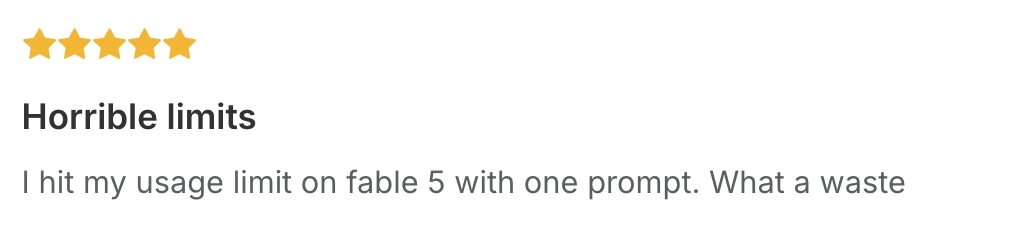
Five stars. Clearly negative feedback. Exactly the kind of nuance that sentiment analysis captures, and average ratings don't.
The Conversation Shifted from Access to Pricing
In June, users were frustrated because Fable had disappeared. In July, they were frustrated because it had returned under different pricing. The language changed noticeably. Instead of words like removed, unavailable, and refund, reviews centered around:
- credits
- paywall
- limits
- bait and switch
Many reviewers had subscribed specifically for Fable, only to see access change weeks later.
One reviewer wrote:

Another review made the same point about paying twice for the same product:
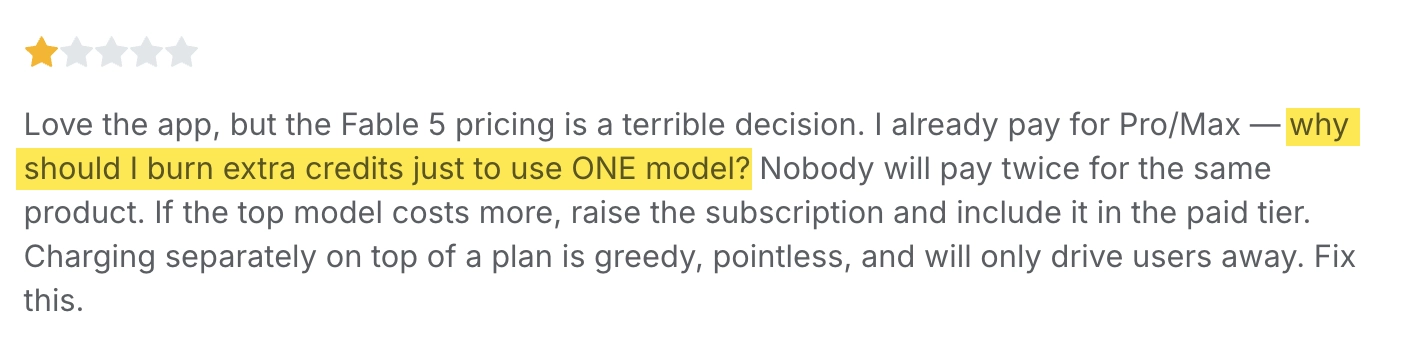
The model itself continued receiving praise across multiple languages. The complaints were about packaging, not performance. That distinction matters.
A New Topic Appeared
The most interesting finding wasn't about pricing. It was a brand-new topic that barely appeared in June. Users began reporting prompts being flagged unexpectedly and conversations automatically switching away from Fable.
Across multiple languages, reviewers described:
- coding prompts being rejected
- educational questions being flagged
- conversations switching models without explanation
Unlike the pricing discussion, this was product feedback. It's also exactly why ongoing topic analysis matters. If your reporting only looks at last month's issues, you'll completely miss this month's.
Timing Told the Story
Fable reviews didn't arrive evenly across the month.
- July 1–7: 42 reviews. Fable returns, and the usage-credit plan is announced.
- July 18–24: 42 reviews. The pricing change takes effect.
Two identically sized spikes, one for each access event. Together, those two weeks account for 58% of the month's entire Fable conversation. Volume dipped between them, and after July 24 it fell away almost completely, to roughly two reviews a day for the rest of the month. Taken together with our June analysis, a pattern emerges:
Users don't review products on a schedule. They review changes: launches, pricing updates, feature removals, and policy changes. Those moments generate conversation far more reliably than day-to-day product quality.
Android and iOS Users Reacted Differently
Overall, Google Play users continued rating Claude more positively than iOS users: 3.68★ across 8,835 reviews, versus 3.13★ across 2,255 reviews. But when we isolated Fable reviews, that relationship flipped.
| Platform | Overall Rating | Fable Rating |
|---|---|---|
| Google Play | 3.68★ | 2.48★ |
| iOS | 3.13★ | 2.91★ |
Android users were significantly more critical of Fable's pricing: 64% of Google Play Fable reviews carried negative sentiment, compared with 52% on iOS. They were also much more likely to compare Anthropic against competing AI models. Looking only at overall ratings would never reveal that shift.
Reviews Aren't Static
Several reviewers updated their reviews as the month progressed. One user increased their rating from one star to four after a new model release addressed their main complaint. Another repeatedly edited their review to document each policy update.
App reviews aren't one-time opinions. They're ongoing customer conversations.
That makes replying to reviews, and analyzing them continuously, far more valuable than treating monthly reports as historical snapshots.
What Product Teams Can Learn
Looking across both studies, a few themes stand out.
- Ratings measure satisfaction. Review text explains why.
- The same star rating can represent completely different problems.
- Customer conversations evolve faster than dashboards.
- Pricing changes generate just as much feedback as product launches.
- Trust is built, or lost, through product decisions, not just product quality.
Most importantly, July showed how quickly customer feedback changes. In June, the conversation was about losing access. By July, it was about paying for access. Without continuously analyzing review text, those are easy to mistake for the same problem. They're not.
How Can You Find Changes Like This in Your Own App Reviews?
You don't need to manually read thousands of reviews to spot these kinds of shifts. Start by filtering reviews around the product, feature or issue you want to investigate, then compare the results across meaningful time periods. From there, look at changes in sentiment, Topics, Custom Topics and Keywords alongside your star ratings.
For example, if you released a major feature last month, you could compare reviews from the month before and after the release, then filter down to reviews mentioning that feature. If sentiment changed, look at the Topics and Keywords associated with the negative feedback to understand what's driving it.
It can also be useful to compare review volume against known events such as releases, pricing changes, feature launches or outages. When review volume suddenly increases, drilling into the language customers are using during that period can help explain what triggered the change.
This analysis was produced using Ask Appbot, analyzing 11,090 reviews in minutes across ratings, sentiment, topics, keywords and review timing. Instead of manually reading thousands of reviews or exporting everything into spreadsheets, we could ask questions of the review data, follow interesting patterns and then drill down into the reviews behind them.
The real question isn't whether your customers are talking. It's whether you're noticing what changed before next month's reviews tell a different story again.
Frequently Asked Questions
Why can app review sentiment be different from star ratings?
A star rating and the text of a review capture different parts of the customer experience. A user might give an app four or five stars because they like the product overall while using the review itself to complain about a specific feature, pricing change or recent problem.
That's exactly what we found in the Claude app reviews for the period. More than a third of Fable reviews received four or five stars in July, but only 17.8% of the review text was classified as positive. Analyzing sentiment alongside ratings can help identify these mismatches.
What is a mixed sentiment app review?
A mixed review contains both positive and negative feedback in the same piece of text, such as praise for a product alongside criticism of its price or a recent change.
In this analysis, 15.1% of Fable reviews were classified as mixed. Those reviews are easy to lose in an average rating because the score has to represent both reactions at once, but they often contain the most useful detail about what a customer values and what they want changed.
What can app review sentiment analysis tell product teams?
Sentiment analysis helps product teams understand whether the language customers use is positive, negative or neutral, but it becomes much more useful when combined with information about what those customers are discussing.
For example, knowing that negative sentiment increased is useful. Knowing that negative sentiment increased specifically in reviews discussing pricing, credits or a new feature gives the team something much more concrete to investigate.
Why should app reviews be monitored continuously?
Customer feedback changes as the product changes. New releases, pricing updates, bugs, outages, feature removals and policy changes can all create new topics in app reviews, sometimes without producing a major change in the overall star rating.
Continuous monitoring makes it easier to spot those shifts while they're happening rather than discovering them weeks or months later in an aggregate report.
Can app reviews help identify pricing problems?
Yes. App reviews can contain direct feedback about subscriptions, pricing, paywalls, usage limits, perceived value and changes to existing plans.
In this Claude analysis, pricing-related feedback became much more prominent after Fable returned, even though reviewers continued to speak positively about the model itself. Separating product feedback from pricing feedback made that distinction much clearer.
Can you compare iOS and Android review sentiment?
Yes. Comparing sentiment, ratings and topics by platform can help identify issues that affect iOS and Android users differently.
In this study, Claude's overall Google Play rating was higher than its iOS rating, but Google Play users discussing Fable were actually more negative. That difference only became apparent once we filtered the data down to Fable-related reviews.
Want to find out what changed in your own app reviews?
Try Ask Appbot, free for 14 days →Where to from here?
- Discover effective strategies for app review management to efficiently handle and leverage user feedback.
- Unlock valuable insights into user sentiment with our powerful sentiment analysis tool for informed decision-making.
- Simplify your review tracking process with our efficient review aggregator, providing a centralized view of user feedback.
- Engage with your users effectively by crafting thoughtful responses with our convenient Reply to App Store Reviews feature.
About The Author

Claire is the Co-founder & Co-CEO of Appbot. Claire has been a product manager and marketer of digital products, from mobile apps to e-commerce sites and SaaS products for the past 15 years. She's led marketing teams to build multi-million dollar revenues and is passionate about growth and conversion optimization. Claire loves to work directly with the world's top app companies delivering tools to help them improve their apps. You can connect with her on LinkedIn.
Enjoying the read? You may also like these
 Claude Fable 5: What 15,514 App Reviews Revealed That App Ratings Couldn’t
 We analyzed 15,512 Claude app reviews after the launch and withdrawal of Claude Fable 5. Discover what ratings, sentiment, emotions, topics, and keywords revealed about user reactions.
The word “delight” appeared in 0.6% of grug’s 866 app reviews. The feeling appeared in 42%. What review mining reveals that star ratings and keyword searches miss.
Learn why generic AI alone isn't enough for customer app feedback analysis and how combining LLMs with structured customer intelligence delivers more reliable product insights.
The complete guide to app store review analysis to help app developers improve their app, boost their star ratings and drive higher downloads and revenue.