

Claude Fable 5: What 15,514 App Reviews Revealed That App Ratings Couldn’t
Published 22nd June, 2026 by Claire McGregor
On June 9, 2026, Anthropic launched Claude Fable 5.
Three days later, it was gone.
The model was withdrawn worldwide following a US export-control order, generating significant discussion across Reddit, Hacker News, social media, and the technology press. Much of that conversation focused on the implications of the launch and withdrawal itself. We were interested in something different: how users responded in the app ratings and reviews.
In this overview you'll learn:
- The App Review Star Ratings Suggested One Story
- Sentiment Revealed Something More Complicated
- Emotion Analysis Explained Why
- Topics Explained What Users Were Reacting To
- Words Revealed How Users Described It
- Not Everything Happening That Week Was About Fable
- Two Platforms, Two Different Reactions
- A Global Conversation
- What Product Teams Can Learn

Want to generate best-practice review replies in seconds?
Try Appbot AI Replies, free for 14 days →To find out, we analyzed 15,514 reviews from Claude's iOS and Google Play apps between May 15 and June 14, including 64 app reviews that specifically mentioned Fable or Mythos. The average app review rating was 3.7 stars across both platforms.
Using Appbot's ratings, sentiment analysis, emotion analysis, topic analysis, and word analysis tools, we looked beyond the headlines to understand not just what users were saying, but how they felt and what they were actually reacting to.

What we found is a useful reminder of why ratings alone rarely tell the full story.
The App Review Star Ratings Suggested One Story
When we isolated the 64 app reviews that specifically mentioned Fable or Mythos the average rating was 2.5 stars.

At first glance, the Fable reviews appeared sharply divided. While 57.8% of reviews were one-star reviews, 31.3% were five-star reviews, with very few landing in the middle.
That kind of distribution would normally suggest two opposing camps: users who loved the model and users who hated it. But when we compared ratings with Appbot’s sentiment analysis, a different picture emerged.
If we stopped the analysis there, we'd probably conclude that Fable was simply polarizing. Some users loved it. Some users hated it. That's a reasonable interpretation of the ratings, but it turns out to be incomplete.
On the surface, the app reviews that mention Fable or Mythos looks like a straightforward negative reaction. Analyzing the review text tells a richer story.
Sentiment Revealed Something More Complicated
Comparing the ratings with Appbot's sentiment analysis produced one of the most interesting findings in the dataset.
Among the 64 Fable app reviews the star rating and sentiment breakdown was:

What's striking is that while 37.6% of reviews carried a four- or five-star rating, only 15.6% were classified as genuinely positive.
The reason becomes obvious once you start reading the reviews themselves. Many users were expressing two reactions at the same time. They praised Fable's capabilities, sometimes describing it as the most capable model they had used, while also expressing disappointment that it was no longer available. Others described the model in glowing terms but focused most of their review on the experience of losing access to it.
One of the clearest examples came from several five-star reviews that were classified as mixed rather than positive. The rating suggested approval, but the review text revealed something more complicated. These users weren't simply celebrating the model. They were expressing frustration, disappointment, or concern about losing access to something they valued.
A five-star rating and a positive review are not always the same thing. Users can be highly satisfied with a product while simultaneously being unhappy about changes to its availability, pricing, access, or future. That's exactly the kind of nuance that disappears when feedback is reduced to an average rating.
Emotion Analysis Explained Why
Sentiment tells us whether a review is broadly positive or negative. Analyzing the emotion of the app review text helps explain what's driving the sentiment.
Across the Fable reviews, frustration and disappointment appeared frequently, particularly among users who upgraded specifically to access the model and then lost access shortly afterward. But those emotions rarely appeared in isolation. They often sat alongside appreciation, admiration, and even enthusiasm for the model itself.
That's what makes this dataset unusual. Many users weren't frustrated because they disliked Fable. They were frustrated because they liked it.
A traditional analysis might simply classify these reviews as negative and move on. Looking at the emotions behind them reveals a different story. Some of the strongest negative reactions were attached to some of the strongest praise. Users weren't simply saying that the experience was bad. Many were effectively saying that the experience was excellent and that losing it was disappointing.
That distinction matters. The emotional context changes how the feedback should be interpreted.
Topics Explained What Users Were Reacting To
Once we understood how users felt, the next question was what they were actually reacting to.
Using Appbot's topic analysis, the most common themes within the Fable review set centered around pricing, subscriptions, payments, account access, and availability. Those topics appeared far more frequently than discussions about model quality, hallucinations, or accuracy.
The dominant conversation wasn't about whether Fable was good or bad. Instead, it was about access.
Many reviewers referenced upgrading specifically to use Fable shortly before it became unavailable. Others discussed subscriptions, account access, regional restrictions, or payment-related concerns. While there were certainly discussions about the model itself, the dominant topics suggest that users were often reacting to access and availability rather than evaluating the model's capabilities in isolation.
Topic analysis doesn't tell us how users felt about those issues. It tells us what they were talking about. Combined with sentiment and emotion analysis, it becomes much easier to understand the context surrounding the reaction.
Words Revealed How Users Described It
Topics tell us the subject of a conversation. Words and phrases reveal the language people use when they talk about it.
Across the Fable reviews, recurring terms included words such as refund, subscription, access, available, unavailable, removed, and upgrade.
What stood out was how frequently they appeared alongside language expressing admiration for the model itself. Reviews that described Fable as exceptional often contained the same language of loss and removal as the most critical reviews. Users who praised the model were often using the same vocabulary as users who were unhappy because both groups were talking about the same event.
This is where the different layers of analysis begin to reinforce one another. Topic analysis showed that users were discussing access and availability. Word analysis revealed the language they used to describe that experience. Sentiment analysis revealed the overall tone, while emotion analysis uncovered the mix of frustration, disappointment, appreciation, and admiration running through the conversation.
Timing Revealed When The Reaction Happened
The timing of the reviews tells another interesting story.
If the launch itself had been the primary driver of feedback, we would expect to see the largest concentration of Fable reviews immediately after release. That's not what happened.
Mentions of Fable remained relatively limited during the launch itself before accelerating later in the week. The largest concentration of Fable-related reviews arrived after the withdrawal rather than after the launch.
That timing suggests users weren't primarily going to the app stores to react to gaining access to the model. They were going there to react after access was removed.
Not Everything Happening That Week Was About Fable
One reason we analyzed a full month of reviews rather than focusing only on launch week was to establish a baseline.
Without that context, it would be easy to attribute every trend during the Fable week to the model itself. The broader review data suggests otherwise.
Average ratings had already been declining before Fable launched. Review volume remained broadly consistent throughout the period, and many recurring complaints around login issues, account restrictions, age verification, and regional availability were already present before the launch.
The cleanest Fable-specific signal wasn't a sudden rating collapse or review surge. It was the appearance of reviews discussing Fable itself and the distinct emotional, topical, and linguistic patterns within that subset.
Two Platforms, Two Different Reactions
Comparing the broader review dataset of both iOS and android app reviews for the selected period also revealed notable differences between platforms.
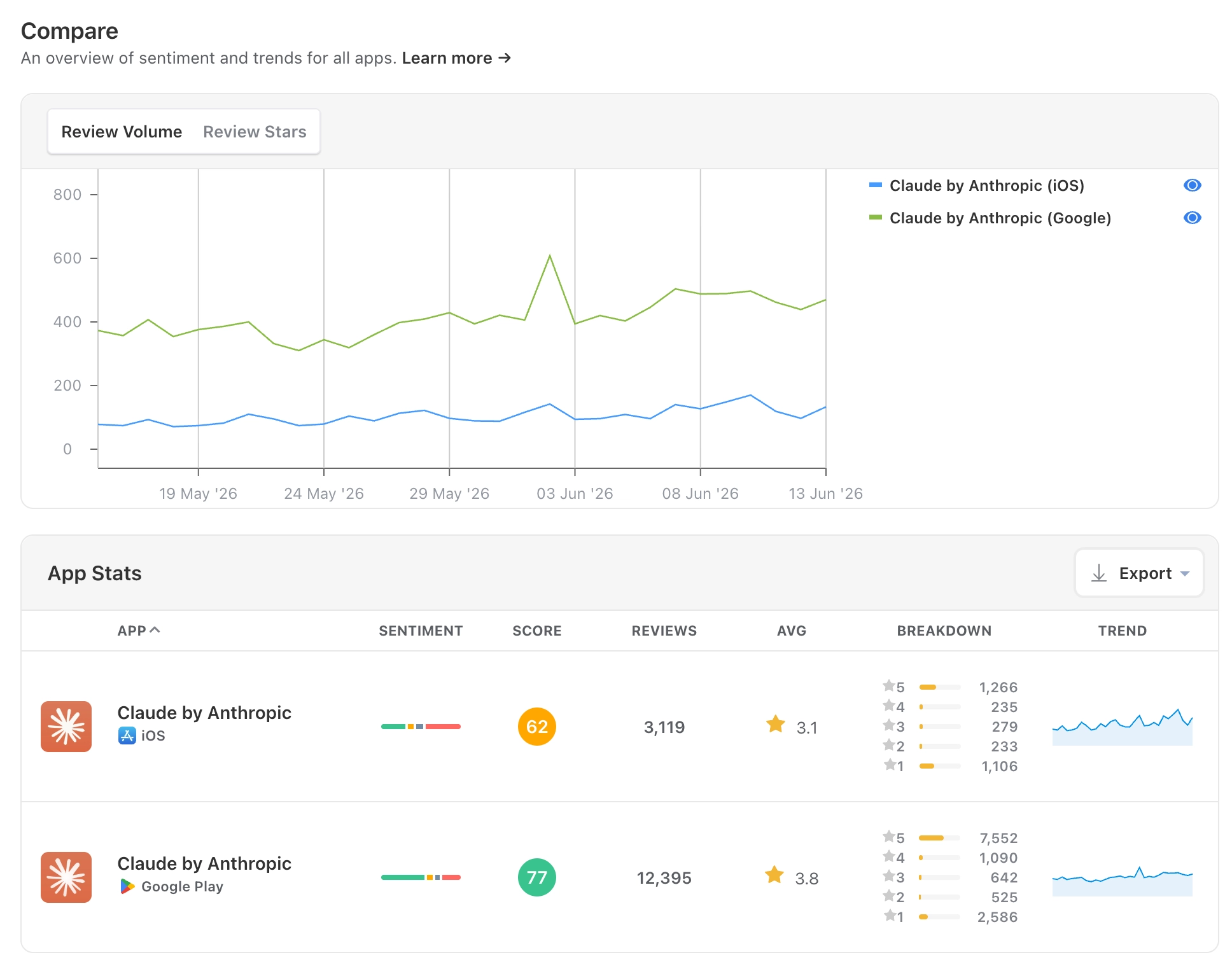
Google Play reviews during the period skewed more positive overall, while iOS reviews skewed more negative. The average rating during the period was 3.8 stars on Google Play compared to 3.1 stars on the App Store. The sentiment analysis told a similar story, with Android achieving an overall sentiment score of 77, compared to 62 for iOS.
Same product. Same event. Different audiences.
It's a useful reminder that aggregate metrics often hide meaningful differences in how users experience and discuss a product. Looking at platform-level feedback separately can uncover patterns that disappear when everything is averaged together.
In this case, Android users were both more positive in their written feedback and more generous with their ratings, while iOS users were substantially more critical. The result was a meaningful gap across both key measures of customer satisfaction: a 15-point difference in sentiment score and a 0.7-star difference in average rating between the two platforms during the same period.
A Global Conversation
The Fable reviews weren't concentrated in a single market.
The iOS reviews mentioning Fable came from countries including the United States, Germany, Slovakia, Brazil, Japan, South Korea, and Morocco. Google Play reviews appeared across multiple languages and a similarly broad geographic spread.
Whatever users thought about the launch and withdrawal, the conversation was clearly global.
What Product Teams Can Learn
The most valuable lesson from this for app developers isn't about Claude or Fable. It's about how different types of analysis reveal different parts of the same story.
If we had looked only at star ratings of app reviews, we would have concluded that Fable generated a strongly negative reaction. That's not wrong, but it's only part of the picture.
As we added more layers of analysis, the story became more nuanced.
- Ratings showed how users scored the experience.
- Sentiment analysis revealed how they felt overall.
- Emotion analysis uncovered the specific emotions behind those reactions.
- Topic analysis identified what users were discussing.
- Word analysis highlighted the language and phrases that appeared most often.
- Timing analysis showed when the reaction peaked.
Viewed together, these signals painted a very different picture from the one implied by the average rating alone. Rather than a simple success story or a straightforward backlash, the reviews revealed a mixture of frustration, disappointment, appreciation, admiration, and enthusiasm, sometimes within the same review.
That's ultimately why review analysis works best when ratings, sentiment, emotions, topics, and words are considered together. Each metric provides another piece of context. Combined, they help explain not just what users are saying, but what they mean.
One final observation: this entire analysis took less than 15 minutes with Ask Appbot - Appbot's proprietary AI-powered app rating and review intelligence with natural language querying.
How long would it take your team to analyze 15,514 reviews and uncover the same insights?
Want to generate best-practice review replies in seconds?
Try Appbot AI Replies, free for 14 days →Where to from here?
- Discover effective strategies for app review management to efficiently handle and leverage user feedback.
- Unlock valuable insights into user sentiment with our powerful sentiment analysis tool for informed decision-making.
- Simplify your review tracking process with our efficient review aggregator, providing a centralized view of user feedback.
- Engage with your users effectively by crafting thoughtful responses with our convenient Reply to App Store Reviews feature.
About The Author

Claire is the Co-founder & Co-CEO of Appbot. Claire has been a product manager and marketer of digital products, from mobile apps to e-commerce sites and SaaS products for the past 15 years. She's led marketing teams to build multi-million dollar revenues and is passionate about growth and conversion optimization. Claire loves to work directly with the world's top app companies delivering tools to help them improve their apps. You can connect with her on LinkedIn.
Enjoying the read? You may also like these
 How Hank Green's Focus Friend App is Winning Hearts (and Ratings)
 Discover how Hank Green’s Focus Friend app is winning over users with its cozy design, emotional resonance, and sky-high ratings. A deep dive into what’s driving its viral success.
What Apple offer codes are, how they differ from promo codes, and how to set them up to win back subscribers and lift App Store conversions.
A complete guide to App Store product page optimization in 2026 — custom product pages, A/B testing, and metadata that converts more installs.
Great app ideas don’t start with features - they start with solving problems. Learn how to uncover, validate, and act on everyday pain points that lead to successful apps.