

WWDC 2026 App Store Discovery Changes: What App Teams Need to Know
Published 11th June, 2026 by Claire McGregor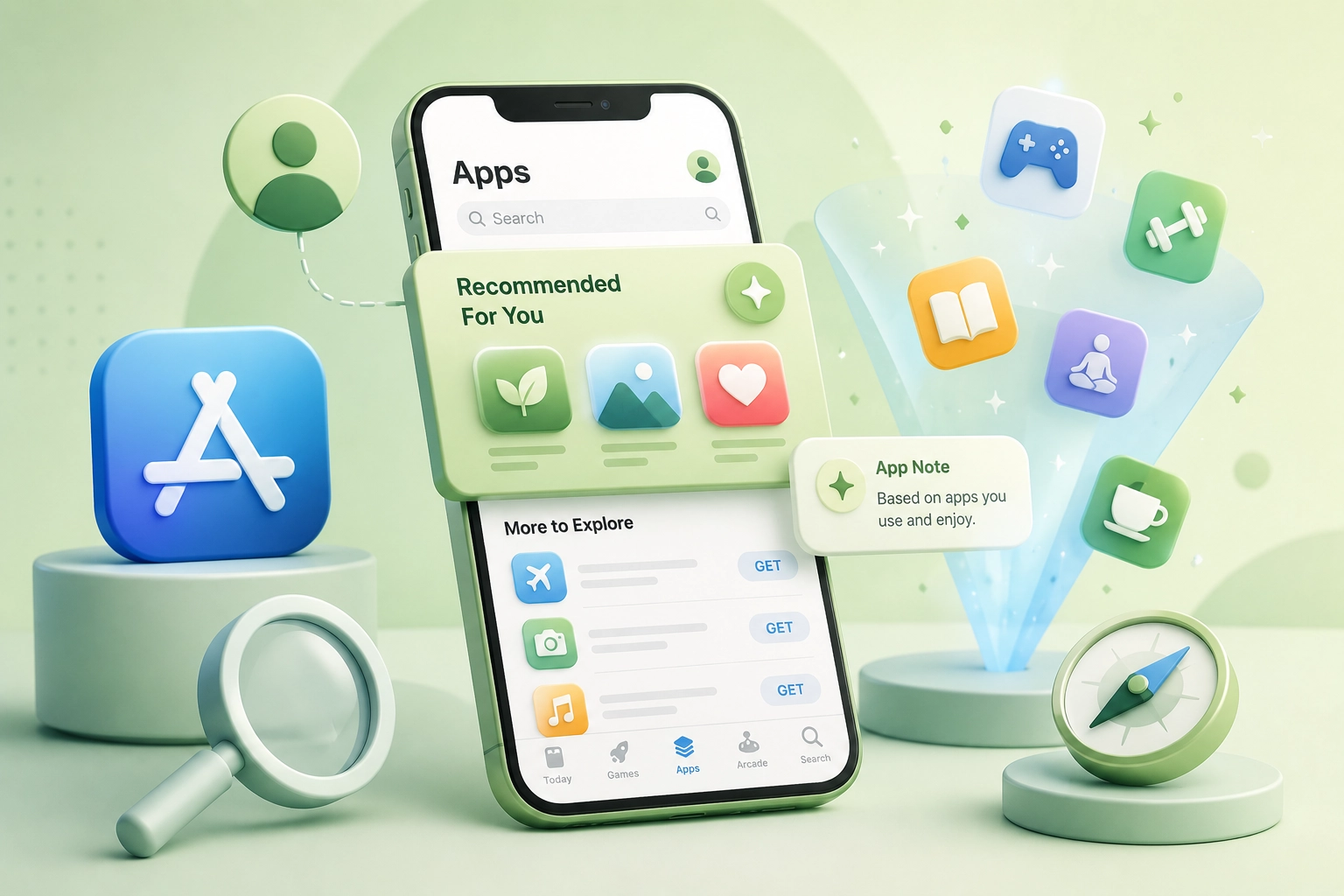
Apple's WWDC 2026 keynote introduced one of the biggest changes to App Store discovery in years.
While much of the attention focused on Siri AI, Foundation Models, and updates to Apple's Liquid Glass design language, Apple also announced a new generation of personalized App Store recommendations powered by on-device intelligence.
The introduction of Personalized Collections and App Notes signals a shift away from one-size-fits-all discovery and toward a more individualized App Store experience. For app developers, marketers, and product teams, that raises an important question: how will users discover apps in a world where recommendations become increasingly personalized?
What we cover:
- Personalized Collections Bring Individualized Discovery
- Apple's Discovery Strategy Has Been Building for Years
- Product Pages Are Becoming More Visual
- Discovery Wasn't the Only App Store Change
- How WWDC 2026 Changes App Store Discovery
- What Does This Mean for App Teams?
- Why Customer App Feedback Matters
- What App Teams Should Do Next
- Final Thoughts
- Frequently Asked Questions About WWDC 2026 App Store Discovery Changes

Want to monitor & track your app reviews?
Try Appbot free now, no credit card needed →These changes could have significant implications for App Store Optimization (ASO), app marketing, customer acquisition, and long-term app growth strategies. While Apple hasn't revealed exactly how Personalized Collections work, the announcements provide important clues about the future of App Store discovery.
Here's what Apple announced, what it means for app growth, and why understanding customer feedback may become even more important.
Personalized Collections Bring Individualized Discovery
One of the most significant App Store announcements at WWDC 2026 was the introduction of Personalized Collections.Rather than showing the same recommendations to every user, Apple can now recommend apps based on a person's existing downloads and app activity, using on-device intelligence to protect privacy. Apple also introduced App Notes, which explain why a particular app appears in a recommendation.
For users, this means a more relevant App Store experience. For developers, it could mean that App Store discovery becomes less dependent on broad popularity and more dependent on how well an app resonates with the users most likely to benefit from it.
This doesn't replace traditional discovery channels such as search, categories, charts, or editorial features. Instead, it adds a new layer of personalization that could become increasingly influential over time.
Apple's Discovery Strategy Has Been Building for Years
The move toward personalized recommendations didn't happen overnight. At WWDC 2025, Apple introduced App Store Tags, AI-generated labels designed to help Apple's systems better understand what apps do and who they're for. Those tags are generated using large language models and then reviewed by humans before being applied.
Viewed together, the 2025 and 2026 announcements tell a coherent story.
First, Apple improved its ability to understand apps. Now, Apple is improving its ability to match those apps with the people most likely to find them useful.
The long-term direction appears to be an App Store that relies less on generic rankings and more on intelligent recommendations.
Product Pages Are Becoming More Visual
WWDC 2026 also introduced new creative tools within App Store Connect. Developers can now manage creative assets through a centralized Asset Library and preview how product pages will appear across different App Store surfaces.
These changes continue a broader trend toward visual discovery. As product pages become richer and more customizable, screenshots, videos, and creative assets become increasingly important marketing tools.
Many teams still treat App Store screenshots as a checklist item. Apple's latest updates suggest they should be viewed as a growth lever instead. Teams that clearly communicate their value proposition visually may gain an advantage as discovery experiences evolve.
Discovery Wasn't the Only App Store Change
Personalized recommendations weren't the only App Store announcement at WWDC 2026. Apple also introduced several new tools designed to help developers improve monetization and reach new customers.
Highlights included:
- Cross-developer App Store Bundles
- Group and organizational subscriptions through StoreKit 2
- Volume purchasing support through Apple Business Manager and Apple School Manager
- Featuring Nominations for promotional game content
While these changes don't directly affect App Store discovery, they demonstrate Apple's broader focus on helping developers improve both visibility and revenue.
Together, these updates suggest Apple is investing heavily in the entire app growth lifecycle, from discovery and acquisition through to conversion and retention.
How WWDC 2026 Changes App Store Discovery
Apple's latest announcements don't replace existing App Store discovery methods, but they do expand them.
| Before | After |
|---|---|
| Charts and rankings dominated discovery | Personalized recommendations play a larger role |
| Many users saw similar recommendations | Recommendations are increasingly tailored to individuals |
| Discovery relied heavily on search and categories | Discovery includes personalized collections and recommendations |
| Developers focused primarily on keywords and metadata | Developers must also focus on relevance, positioning, and customer satisfaction |
| Limited context for recommendations | App Notes explain why apps are being recommended |
For developers, this means App Store discovery is becoming more personalized and potentially more competitive. Understanding your audience and communicating your value clearly may become increasingly important as Apple's recommendation systems evolve.
What Does This Mean for App Teams?
The immediate impact is that app teams may need to think about discoverability differently.
Historically, App Store Optimization focused heavily on:
- Keywords
- Metadata
- Rankings
- Conversion rates
Those factors still matter. However, as recommendation systems become more sophisticated, understanding users becomes just as important as understanding algorithms. The teams that succeed will be the ones that consistently deliver experiences users value and recommend.
Why Customer App Feedback Matters
Apple has not disclosed which signals influence Personalized Collections. We don't know whether ratings, reviews, engagement, retention, subscriptions, or other metrics play a role.
What we do know is that customer feedback remains one of the fastest ways to understand how users experience your product.
Reviews often reveal:
- Onboarding friction and usability issues
- Bugs and performance problems
- Customer expectations and unmet needs
- Features users value most
- Emerging feature requests and product opportunities
Regardless of how Apple's recommendation systems work, acting on this feedback helps improve the customer experience. Better customer experiences tend to lead to stronger retention, higher ratings, and more sustainable growth.
For product teams, app reviews provide an ongoing stream of insight into what users love, what frustrates them, and what they want next. Tracking recurring themes, sentiment shifts after releases, and emerging requests can help teams prioritize improvements that matter most to customers.
This is where Appbot can help. Instead of manually reading hundreds or thousands of reviews, teams can automatically track sentiment, identify recurring issues, monitor feature requests, and uncover emerging trends across app stores. These insights make it easier to understand customer needs and prioritize improvements based on real user feedback.
As App Store discovery becomes more personalized, understanding customer needs becomes increasingly important. Whether or not reviews directly influence recommendations, the insights they contain can help teams build better products and create experiences users are more likely to keep using and recommending.
What App Teams Should Do Next
WWDC 2026 doesn't mean traditional ASO is dead. Keywords, metadata, screenshots, ratings, and conversion rates remain important. But the App Store is clearly evolving toward a more personalized model.
App teams should consider:
Review Your Positioning
Can users immediately understand what your app does, who it's for, and why it's valuable?
Invest in Creative Assets
Treat screenshots and App Preview videos as marketing assets, not compliance requirements.
Monitor Customer Feedback
Look beyond star ratings and identify recurring themes, frustrations, and feature requests.
Focus on User Satisfaction
Retention, engagement, and customer satisfaction remain among the most important growth drivers available to any app team.
Final Thoughts
WWDC 2026 signals a clear shift toward a more personalized App Store experience.
While Apple hasn’t revealed exactly how Personalized Collections work, the direction is clear: helping users discover apps that are genuinely relevant to them.
For app teams, that makes understanding customer needs more important than ever. The teams that listen to feedback, improve their products, and clearly communicate their value will be best positioned to succeed as App Store discovery continues to evolve.
Frequently Asked Questions About WWDC 2026 App Store Discovery Changes
What are Personalized Collections in the App Store?
Personalized Collections are a new App Store discovery feature announced at WWDC 2026. They use on-device intelligence to recommend apps based on a user's downloads and app activity.
What are App Notes?
App Notes explain why a particular app has been recommended to a user, providing additional context within Personalized Collections.
Does WWDC 2026 change App Store Optimization?
Traditional ASO factors such as keywords, metadata, screenshots, ratings, and conversion rates remain important. However, Apple's move toward personalized recommendations may increase the importance of product positioning, customer satisfaction, and understanding user needs.
Does Apple use app reviews for recommendations?
Apple has not disclosed which signals influence Personalized Collections. While reviews may contribute to broader measures of customer satisfaction, Apple has not confirmed whether review sentiment directly affects recommendations.
What do WWDC 2026's App Store changes mean for developers?
The changes suggest Apple is investing heavily in personalized App Store discovery, richer product pages, and new monetization tools. Developers should focus on clear messaging, strong creative assets, customer feedback, and delivering experiences users find valuable.
Want to monitor & track your app reviews?
Try Appbot free now, no credit card needed →Where to from here?
- Explore the strategies employed by top grossing apps and learn how to achieve success.
- Master the art of writing an irresistible app store description that captures attention and drives downloads.
- Reply to app store reviews on the Apple and Google Play stores for happier customers and better star ratings.
- Dive into the secrets of creating addictive apps that keep users hooked and coming back for more.
About The Author

Claire is the Co-founder & Co-CEO of Appbot. Claire has been a product manager and marketer of digital products, from mobile apps to e-commerce sites and SaaS products for the past 15 years. She's led marketing teams to build multi-million dollar revenues and is passionate about growth and conversion optimization. Claire loves to work directly with the world's top app companies delivering tools to help them improve their apps. You can connect with her on LinkedIn.
Enjoying the read? You may also like these
 WWDC 2026: Apple’s Foundation Models Become a Hybrid AI Platform
 Learn how Apple’s new Retention Messaging API helps reduce app subscription churn with personalized, in-the-moment messages. Backed by research, this guide shows how to combine App Store feedback, discounts, and smart messaging to boost retention.
A complete guide to App Store product page optimization in 2026 — custom product pages, A/B testing, and metadata that converts more installs.
How Apple's App Store Small Business Program drops commission from 30% to 15%, who qualifies, and how to enroll — plus Google Play's equivalent.
Great app ideas don’t start with features - they start with solving problems. Learn how to uncover, validate, and act on everyday pain points that lead to successful apps.