

WWDC 2026: Apple’s Foundation Models Become a Hybrid AI Platform
Published 8th June, 2026 by Stuart Hall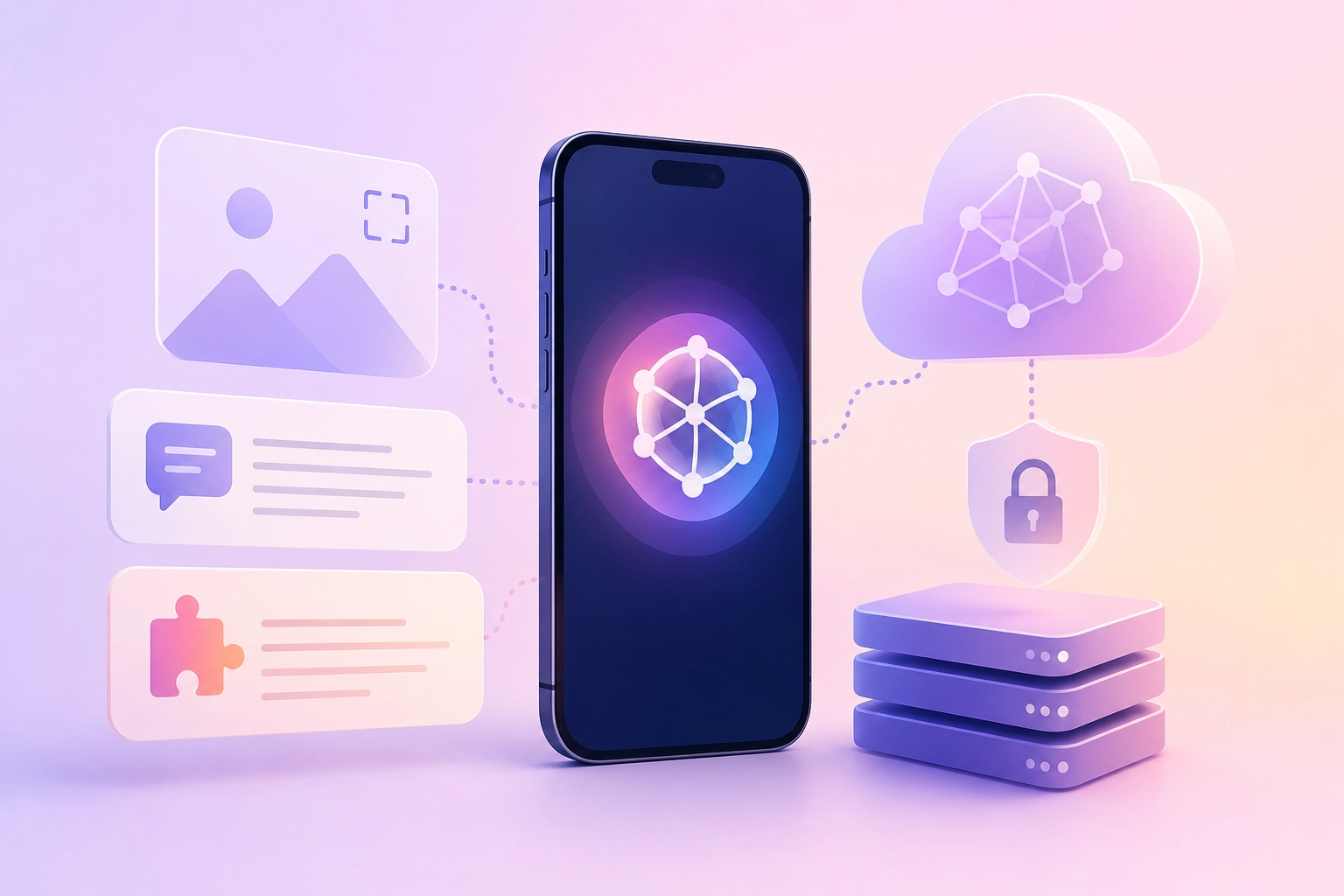
At WWDC 2025, Apple introduced the Foundation Models framework framework and gave developers access to the on-device model behind Apple Intelligence.
The pitch was simple: private, offline AI built directly into Apple platforms.
Developers could add summarization, classification, extraction, and generation features without managing external APIs, paying per-token costs, or sending user data to third-party providers.
One year later, Apple has dramatically expanded that vision.
What we cover:
- The Big Story: Foundation Models Go Hybrid
- A Quick Refresher: What Are Foundation Models?
- Foundation Models Are Becoming Multimodal
- Custom Skills Move Beyond Content Generation
- Server-Side Execution Expands What Apps Can Do
- Apple's AI Ecosystem Is Expanding
- Core AI Signals Apple's Long-Term Direction
- Why This Matters for Product Teams
- The Bigger Picture
- FAQ: 2026 Apple AI Foundation Model

Want to monitor & track your app reviews?
Try Appbot free now, no credit card needed →WWDC 2026 marks a turning point for Apple’s AI strategy. The Foundation Models framework is no longer just an on-device AI capability. It is now part of a hybrid AI platform that combines local models, cloud-scale intelligence, multimodal reasoning, and a surprising new partnership with Google.
For developers building AI-powered apps, this may be the most important platform shift Apple announced this year.
It also signals a broader change in user expectations. As AI becomes deeply embedded across Apple’s ecosystem, users will increasingly expect apps to understand context, automate routine tasks, and deliver intelligent assistance while maintaining strong privacy protections.
In this article, we'll explore what Apple announced, how the Foundation Models framework is evolving, and what it means for product teams building the next generation of AI-powered experiences.
The Big Story: Foundation Models Go Hybrid
The most important announcement wasn't any individual AI feature.
It was a fundamental change in how Apple delivers AI capabilities to developers.
When Foundation Models launched in 2025, developers primarily worked with an on-device model. The value proposition centered around privacy, offline functionality, and deep integration with Apple devices.
At WWDC 2026, Apple expanded that architecture.
Developers can now access AI capabilities that span both on-device execution and cloud-based processing through Apple's broader AI platform.
| On-Device AI | Cloud AI |
|---|---|
| Privacy-sensitive tasks | Advanced reasoning |
| Low-latency interactions | Complex workflows |
| Offline experiences | Large-scale processing |
| Reduced infrastructure requirements | Higher capability ceiling |
Not every task requires cloud-scale AI. Not every task can be handled effectively on-device.
Apple's updated approach allows developers to choose the right level of intelligence for each use case while maintaining a consistent development experience.
WWDC 2026 wasn't just about making Foundation Models smarter. It was about transforming them into a hybrid AI platform.
That flexibility may ultimately matter more than any individual model upgrade.
A Quick Refresher: What Are Foundation Models?
Foundation Models is Apple's framework that gives developers access to the technologies behind Apple Intelligence.
When it launched, the framework focused heavily on on-device execution. Developers could generate text, summarize information, classify content, and perform language-related tasks directly on a user's device.
That approach offered several advantages:
- Privacy-first AI
- Offline functionality
- Lower infrastructure complexity
- Reduced dependence on third-party AI services
For apps handling personal information, productivity workflows, journaling, education, or health-related content, Foundation Models provided an attractive alternative to cloud-only AI solutions.
The framework quickly became one of the most interesting additions to Apple's developer ecosystem because it allowed teams to experiment with AI while remaining aligned with Apple's privacy-first philosophy.
Foundation Models Are Becoming Multimodal
One of the biggest capability upgrades announced at WWDC 2026 is support for image understanding alongside text.
Developers can now work with visual information in addition to language, enabling apps to understand and reason about a broader range of content.
Potential use cases include:
- Understanding screenshots submitted through support workflows
- Analyzing product photos
- Extracting information from documents
- Educational experiences that explain diagrams and worksheets
- Accessibility features that describe visual content
Apple's updates also strengthen integration with existing frameworks such as Vision, allowing developers to combine AI-powered understanding with OCR and other computer vision capabilities.
Last year, Foundation Models primarily focused on language. This year, Apple is clearly moving further into multimodal AI.
Custom Skills Move Beyond Content Generation
Another important addition is support for custom skills.
At first glance, this may sound like a small feature.
In practice, it changes how developers can think about AI-powered experiences.
Previously, Foundation Models primarily generated outputs.
Now they can participate more directly in workflows.
Custom skills allow developers to expose app-specific capabilities to AI systems, enabling them to interact with application functionality rather than simply generating content.
For example, a customer feedback platform could allow an AI assistant to:
- Retrieve recent reviews
- Categorize sentiment
- Surface recurring themes
- Draft responses
- Recommend product improvements
- Trigger follow-up workflows
This aligns Apple with a broader industry trend toward AI systems that can take actions rather than simply produce text.
Server-Side Execution Expands What Apps Can Do
One limitation of the original Foundation Models framework was the capability ceiling imposed by on-device execution.
WWDC 2026 expands those possibilities.
Apple introduced broader support for server-side AI processing through its cloud infrastructure, allowing developers to access more powerful capabilities when needed.
For product teams, this creates a much more practical architecture.
Instead of forcing every AI interaction to run locally or every interaction to run in the cloud, developers can choose the most appropriate execution environment.
Examples might include:
- Running private personal tasks locally
- Processing large documents in the cloud
- Using on-device models for real-time interactions
- Leveraging cloud resources for advanced reasoning workflows
This hybrid approach reflects how many organizations are increasingly deploying AI in practice.
Apple's AI Ecosystem Is Expanding
Another notable theme from WWDC 2026 is Apple's increasingly ecosystem-oriented approach to AI. Historically, Apple has emphasized vertical integration by controlling hardware, software, operating systems, and developer tools.
AI appears to be introducing a more flexible strategy. Apple continues investing heavily in its own AI technologies while also expanding partnerships and integrations across the broader AI landscape.
Rather than positioning itself solely as a model provider, Apple increasingly appears focused on becoming the platform layer that combines:
- On-device intelligence
- Private Cloud Compute
- AI-powered developer tools
- Operating system integration
- Third-party AI capabilities where appropriate
For developers, this ecosystem approach may ultimately be more valuable than access to any individual model.
Core AI Signals Apple's Long-Term Direction
Apple also introduced Core AI, which appears to be part of a broader effort to simplify how developers build AI-powered experiences across Apple platforms.
Historically, developers have navigated multiple AI-related technologies including:
Core AI suggests Apple is moving toward a more unified AI architecture.
The significance isn't necessarily what Core AI enables today.
The significance is what it signals about Apple's long-term platform strategy.
As AI becomes increasingly central to application development, developers will likely benefit from a more cohesive framework for building intelligent experiences across Apple's ecosystem.
Why This Matters for Product Teams
The most important takeaway from WWDC 2026 isn't technical. It's strategic.
For years, product teams have faced difficult tradeoffs when building AI features.
| Traditional Challenge | New Possibility |
|---|---|
| Need cloud AI for advanced features | Use local or cloud execution depending on the task |
| Multiple AI vendors and APIs | Access capabilities through a unified platform experience |
| Privacy concerns slowing adoption | Leverage Apple's privacy architecture |
| High AI infrastructure complexity | Rely more on platform-level services |
Apple's new architecture attempts to reduce these tradeoffs.
Developers can increasingly choose:
- On-device execution when privacy matters most
- Cloud execution when advanced reasoning is required
- Visual inputs when image understanding is needed
- Custom skills when actions matter more than content generation
That flexibility lowers the barrier to experimentation.
Instead of debating infrastructure first, teams can focus on solving customer problems.
What This Means for App Reviews and Customer Feedback
As AI becomes a built-in capability of mobile platforms, the nature of customer feedback is about to change.
Historically, app reviews focused on usability, bugs, performance, pricing, and feature requests. But as developers begin shipping AI-powered experiences using Foundation Models, users will increasingly evaluate how well those AI features actually help them accomplish their goals.
That creates a new challenge for product teams.
It's no longer enough to know that users like or dislike a feature. Teams need to understand why users trust an AI-powered experience, where it creates friction, and whether it delivers meaningful value.
Reviews Will Become an Early Warning System
AI features can fail in ways traditional software doesn't.
Users may report that:
- Responses are inaccurate or unhelpful
- AI-generated content feels repetitive
- Features are confusing or difficult to trust
- Results don't match expectations
- AI adds complexity instead of reducing it
These issues often appear in reviews long before they show up in product analytics.
For many teams, customer feedback will become one of the fastest ways to identify AI-related problems and improvement opportunities.
New App Review Themes Will Emerge
As AI-powered experiences become more common, we expect to see more app reviews discussing topics such as:
- AI usefulness
- Accuracy and reliability
- Trust and privacy
- Personalization quality
- Speed of responses
- Whether AI genuinely saves time
These themes cut across traditional app categories and may become important indicators of product success.
The Opportunity for Product Teams
The companies that succeed with AI won't necessarily be the ones with the most advanced models.
They'll be the teams that listen carefully to how customers experience those features and iterate quickly based on feedback.
As AI becomes a larger part of the app experience, understanding customer sentiment about AI-powered workflows may become just as important as tracking crashes, usability issues, or feature requests.
For product teams, reviews won't just tell you what users think about your app.
They'll increasingly tell you what users think about your AI.
The Bigger Picture
At WWDC 2025, Apple gave developers access to on-device language models.
At WWDC 2026, Apple unveiled something much larger: a hybrid AI platform.
1. AI Features Will Become More Native
As Foundation Models expands, more developers will build AI-powered experiences directly into their apps rather than relying entirely on external services.
2. Hybrid AI May Become the Default Architecture
The combination of on-device intelligence and cloud-scale processing reflects where the broader industry is heading.
The future is increasingly both local and cloud-based.
3. User Expectations Are Changing
As AI becomes embedded within operating systems and frameworks, users will begin expecting intelligent experiences throughout everyday applications.
Features that once felt innovative may quickly become standard.
4. Customer Feedback Becomes More Important
As apps adopt AI-powered workflows, teams will need to understand not only whether users like a feature, but whether they trust it and find it genuinely useful.
5. Platform Strategy Matters More Than Models
The most important announcement wasn't image understanding, custom skills, or server-side execution on their own.
It was Apple's move toward a unified AI platform that combines privacy, intelligence, flexibility, and developer accessibility.
The AI industry is increasingly becoming a competition between ecosystems rather than individual models.
WWDC 2026 suggests Apple understands that shift. The story isn't simply that Foundation Models became smarter.
It's that Apple transformed Foundation Models from an on-device AI feature into the foundation of a broader AI platform: one designed to balance privacy, capability, flexibility, and developer adoption.
For app teams building the next generation of AI-powered experiences, that may prove to be one of the most consequential announcements of the entire conference.
As AI becomes a larger part of every app experience, understanding how users respond to those experiences will become increasingly important.
That's where customer feedback, review analysis, and Voice of Customer insights will continue to play a critical role.
FAQ: 2026 Apple AI Foundation Model
What are Apple's Foundation Models?
Apple's Foundation Models are AI models that power Apple Intelligence and are accessible to developers through Apple's Foundation Models framework. The framework allows developers to add AI capabilities such as text generation, summarization, classification, and content understanding directly into their apps while leveraging Apple's privacy-focused architecture.
What did Apple announce for Foundation Models at WWDC 2026?
At WWDC 2026, Apple expanded Foundation Models beyond on-device language processing by introducing multimodal capabilities, custom skills, and broader support for cloud-based AI execution. These updates transform Foundation Models from a standalone AI feature into a more comprehensive hybrid AI platform for developers.
What is a hybrid AI platform?
A hybrid AI platform combines on-device AI processing with cloud-based AI services. This approach allows developers to use local AI for privacy-sensitive and low-latency tasks while leveraging cloud infrastructure for more complex reasoning, larger workloads, and advanced AI capabilities.
Can Apple Foundation Models run entirely on-device?
Yes. One of the key advantages of Foundation Models is the ability to run many AI tasks directly on Apple devices. This enables offline functionality, improves privacy, reduces latency, and minimizes the need to send user data to external servers.
How do Apple's Foundation Models differ from traditional cloud AI services?
Traditional cloud AI services process requests on remote servers, while Apple's Foundation Models can run many tasks directly on a user's device. This approach improves privacy, enables offline functionality, reduces latency, and gives developers more flexibility in how AI features are delivered.
What is multimodal AI?
Multimodal AI refers to AI systems that can understand and process multiple types of information, such as text and images. With multimodal capabilities, apps can analyze screenshots, photos, documents, and visual content alongside written language to provide richer user experiences.
Why is multimodal AI important for app developers?
Multimodal AI enables developers to build experiences that understand visual and textual information together. This can support use cases such as customer support, accessibility, document analysis, education, product discovery, and customer feedback analysis.
What are custom skills in Apple's Foundation Models?
Custom skills allow developers to expose app-specific actions and workflows to AI systems. Instead of only generating content, AI can interact with application functionality, retrieve information, perform actions, and support more complex user workflows.
What is Private Cloud Compute?
Private Cloud Compute is Apple's cloud infrastructure designed to extend AI capabilities beyond the device while maintaining Apple's privacy standards. It enables more advanced AI processing when tasks require capabilities that exceed what can run efficiently on-device.
How does Apple's AI strategy compare to OpenAI, Anthropic, and Google?
Apple's AI strategy focuses heavily on privacy, on-device processing, operating system integration, and developer experience. While companies such as OpenAI, Anthropic, and Google primarily deliver AI through cloud-based services, Apple combines local AI, cloud infrastructure, and platform-level integration to create a more seamless user experience across its ecosystem.
Will Apple Foundation Models replace OpenAI, Anthropic, or Google Gemini APIs?
Not necessarily. Many developers will continue using external AI providers for advanced capabilities and specialized use cases. However, Foundation Models may reduce reliance on third-party APIs for common AI tasks by providing native AI capabilities directly within Apple's ecosystem.
What are the benefits of hybrid AI for mobile app developers?
Hybrid AI gives developers greater flexibility by allowing them to balance privacy, performance, cost, and capability. Developers can use on-device AI for fast, privacy-sensitive tasks while leveraging cloud-based AI for more demanding workflows and advanced reasoning.
How will WWDC 2026 impact AI app development?
WWDC 2026 lowers the barriers to building AI-powered applications by giving developers access to more capable AI tools through Apple's ecosystem. Developers can increasingly add intelligent features without building and maintaining complex AI infrastructure themselves.
How will AI affect customer feedback and app reviews?
As AI becomes a core part of app experiences, users will increasingly review and evaluate AI-powered features alongside traditional functionality. Product teams will need to understand feedback related to AI accuracy, trust, usefulness, privacy, reliability, and overall user experience.
Why is customer feedback important for AI-powered apps?
Customer feedback helps teams understand whether AI features are solving real user problems. Reviews, surveys, and support conversations can reveal issues related to accuracy, trust, usability, and adoption that may not be visible through product analytics alone.
How can product teams measure the success of AI features?
Product teams can measure AI success by combining usage data with customer feedback such as app ratings and reviews. Metrics such as adoption, retention, task completion, user satisfaction, sentiment, review themes, and support ticket trends help teams understand how customers perceive AI-powered experiences.
Want to monitor & track your app reviews?
Try Appbot free now, no credit card needed →Where to from here?
- Explore the strategies employed by top grossing apps and learn how to achieve success.
- Master the art of writing an irresistible app store description that captures attention and drives downloads.
- Reply to app store reviews on the Apple and Google Play stores for happier customers and better star ratings.
- Dive into the secrets of creating addictive apps that keep users hooked and coming back for more.
About The Author

Stuart is Co-founder & Co-CEO of Appbot. Stuart has been involved in mobile as a developer, blogger and entrepreneur since the early days of the App Store. He built the 7 Minute Workout app in one night and blogged the story of growing the app to 2.3 million downloads before exiting to a large fitness device company. Previously he was the co-founder of the Discovr series of applications which achieved over 4 million downloads. You can connect with him on LinkedIn.
Enjoying the read? You may also like these
 Age Verification APIs for Apps: Apple & Google Rules (2026)
 What the new Apple and Google age-verification requirements mean for your app, and which APIs to use to comply without hurting the user experience.
A complete guide to App Store product page optimization in 2026 — custom product pages, A/B testing, and metadata that converts more installs.
How Apple's App Store Small Business Program drops commission from 30% to 15%, who qualifies, and how to enroll — plus Google Play's equivalent.
Great app ideas don’t start with features - they start with solving problems. Learn how to uncover, validate, and act on everyday pain points that lead to successful apps.